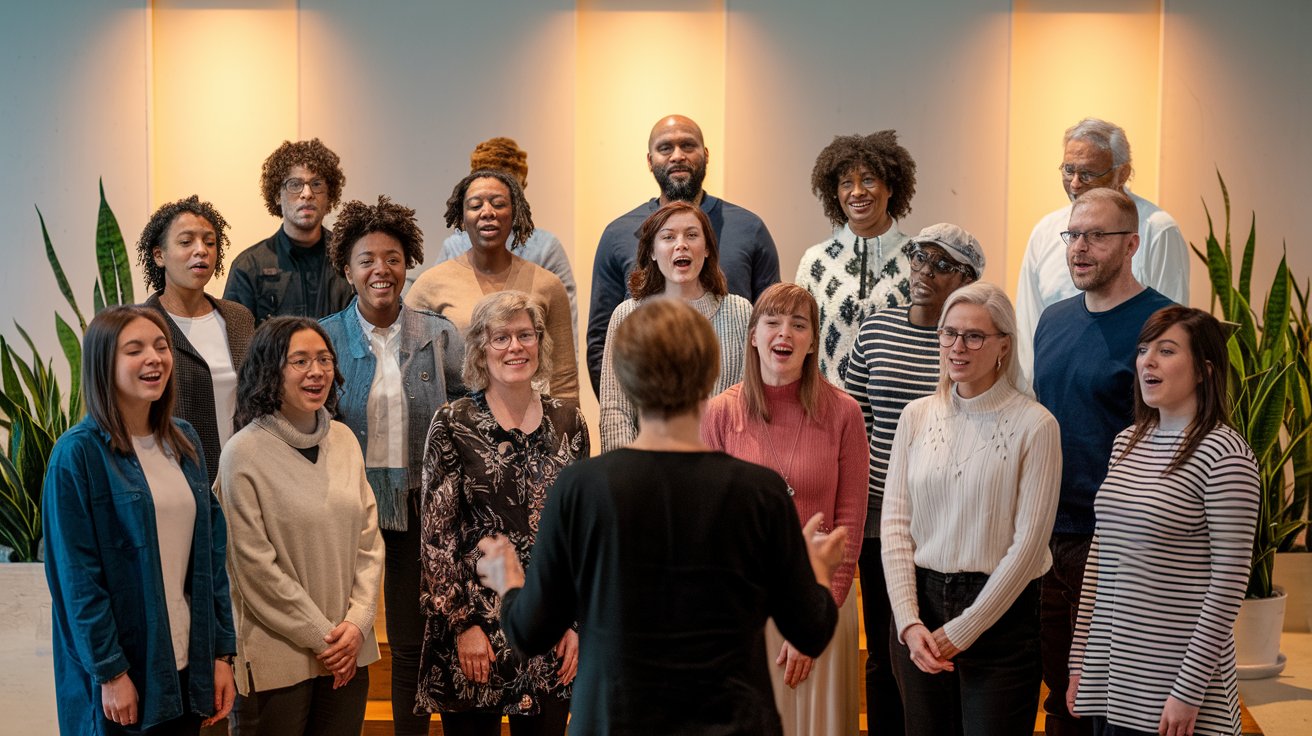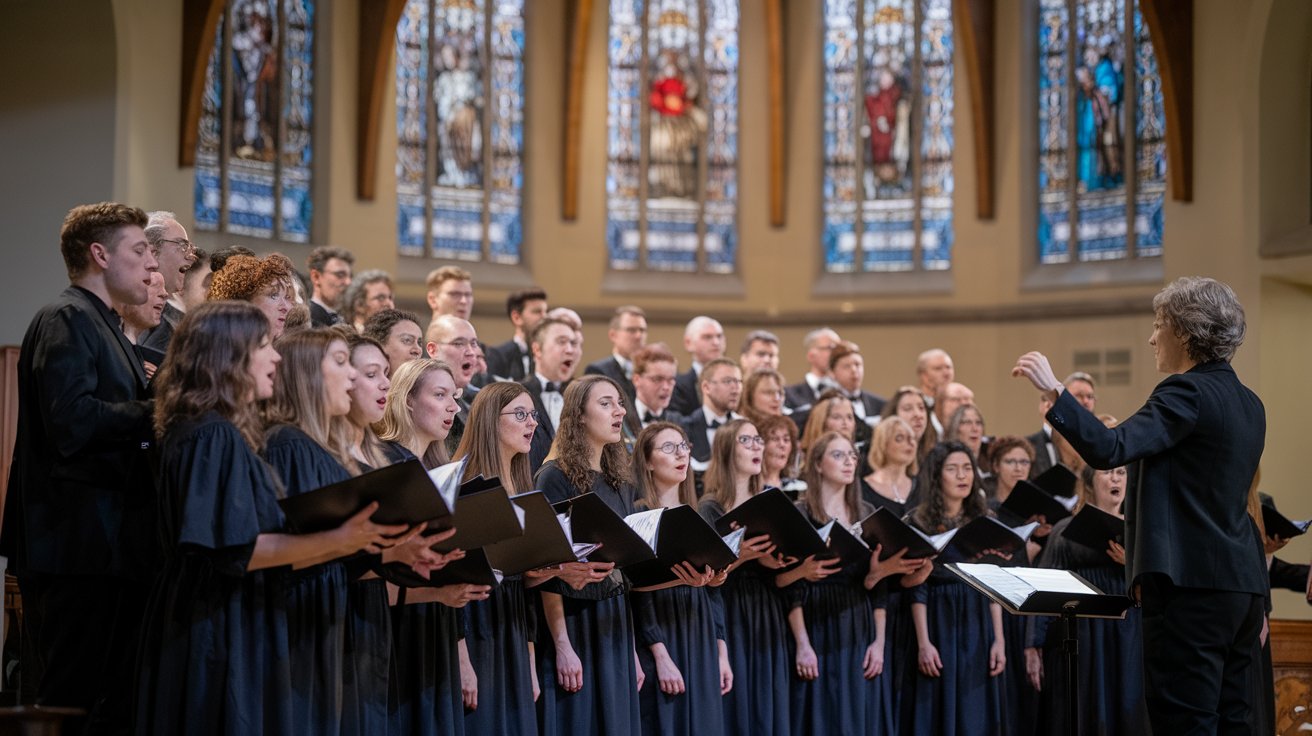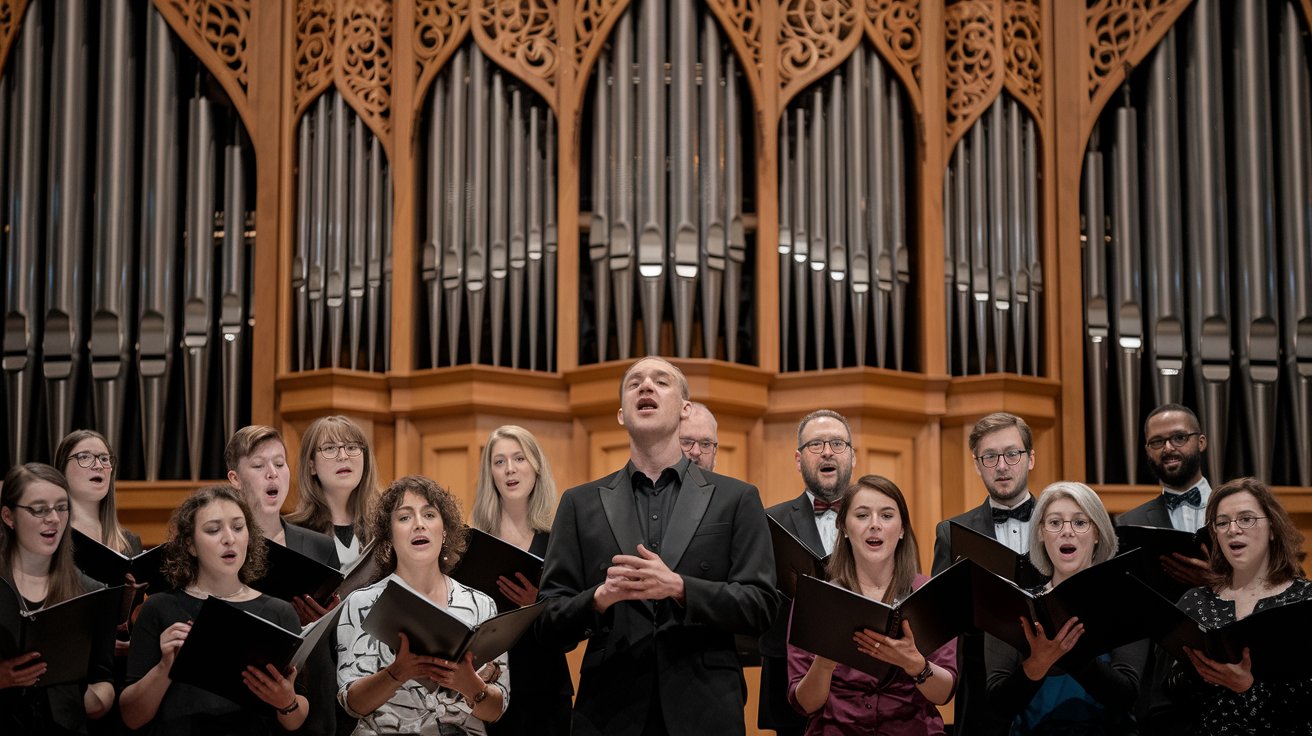
A choir is an organized group of singers who perform together, typically arranged by vocal ranges such as soprano, alto, tenor, and bass. In the United States, approximately 42.6 million adults participate in choral singing as of 2026, making it one of the most popular group musical activities. Whether performing in churches, schools, concert halls, or community centers, choirs create harmonious music through coordinated vocal performance under the direction of a conductor or choir director.
What Classifies a Choir
A choir is classified as a vocal ensemble consisting of multiple singers performing together, typically with more than one person singing each vocal part. The fundamental characteristic that classifies a choir is the presence of multiple voices on each part, distinguishing it from smaller vocal groups or solo performances. Most traditional choirs have at least 12-16 members, though professional and community choirs often include 40-100 singers or more.
The organization of a choir involves specific vocal sections based on voice type and range. Standard choral classifications include soprano (highest female voices), alto (lower female voices), tenor (higher male voices), and bass (lowest male voices). In 2026, American choirs increasingly incorporate non-binary voice classifications, focusing on vocal range rather than gender assignment. The choir structure allows for rich harmonic textures that cannot be achieved by smaller singing groups, as multiple voices blend to create fuller, more resonant sound.
Why Is It Called a Choir
The term choir originates from the Latin word ‘chorus,’ which itself derives from the ancient Greek ‘khoros,’ meaning a group of singers and dancers who performed together in theatrical productions. The word evolved through Old French as ‘quer’ before entering Middle English as ‘quere’ and eventually becoming the modern spelling choir around the 14th century. The pronunciation of choir as ‘kwire’ rather than following standard English phonetic patterns reflects its French linguistic heritage.
Historically, choirs were primarily associated with religious institutions, particularly Christian churches where designated areas for singers became known as the ‘choir’ section of the building. This architectural term and the musical group term share the same origin. In medieval cathedrals, the choir referred both to the physical space where clergy and singers gathered and to the singers themselves. Today, while the term is called choir universally, some regions and contexts use alternative terms like ‘chorale,’ ‘chorus,’ or ‘glee club,’ though subtle distinctions exist between these designations in formal musical contexts.
The Purpose of a Choir
The primary purpose of a choir is to create musical harmony through collective vocal performance, producing sounds and emotional experiences that cannot be achieved by individual singers. Choirs serve multiple functions in society, including worship enhancement, artistic expression, community building, and cultural preservation. In religious settings, choirs lead congregational singing, perform sacred music, and enhance liturgical ceremonies. Studies from 2026 show that 68% of American churches maintain active choir programs, demonstrating the continued importance of choral music in worship contexts.
Beyond religious functions, choirs fulfill significant educational and social purposes. School choirs teach music literacy, teamwork, discipline, and performance skills to students from elementary through university levels. Research published in 2026 indicates that students participating in choir programs demonstrate 23% higher academic performance in reading and mathematics compared to non-participants. Community choirs provide social connection, mental health benefits, and creative outlets for adults, with participation linked to reduced anxiety, improved mood, and stronger community bonds. Professional choirs preserve and advance choral repertoire, commissioning new works and maintaining performance standards that inspire amateur groups nationwide.
Four Main Types of Choirs
Understanding the four types of choir helps distinguish different choral traditions and performance contexts. These classifications reflect organizational structure, membership composition, and primary function within musical and community settings. Each type of choir serves distinct purposes while maintaining the fundamental principle of multiple voices performing together in harmony.
Church and Sacred Choirs
Church choirs represent the oldest and most traditional form of organized choral singing in Western culture. These sacred choirs perform primarily during worship services, presenting hymns, anthems, psalms, and liturgical music. In 2026, approximately 127,000 active church choirs operate across the United States, ranging from small volunteer groups of 8-12 singers to large cathedral choirs exceeding 80 members. The church choir typically rehearses weekly and performs on Sundays and special holy days, with repertoire spanning from Gregorian chant to contemporary Christian music. Many church choirs are non-auditioned, welcoming community members regardless of formal musical training, though larger churches often maintain both volunteer and professional paid choir sections.
School and Youth Choirs
School choirs function as educational ensembles within academic institutions, serving students from elementary through university levels. These youth choirs emphasize music education alongside performance, teaching vocal technique, music theory, sight-reading, and ensemble skills. The National Association for Music Education reports that in 2026, approximately 8.3 million American students participate in school choir programs. Educational choirs typically perform varied repertoire including classical pieces, folk songs, popular arrangements, and multicultural works. High school and university choirs often compete in regional and national festivals, with top ensembles achieving remarkable technical proficiency comparable to professional groups. Many schools offer multiple choir levels, from beginner mixed ensembles to advanced auditioned groups like chamber choirs and show choirs.
Community and Amateur Choirs
Community choirs bring together adult singers from diverse backgrounds for the love of choral music and social connection. These amateur choirs are typically non-auditioned or lightly auditioned, welcoming participants with varying musical experience. In 2026, over 12,000 active community choirs operate across the United States, with membership ranging from 20 to over 200 singers. These ensembles rehearse regularly, typically weekly or biweekly, and present concerts several times annually. Community choir repertoire spans classical masterworks, spirituals, folk arrangements, and contemporary compositions. Notable examples include city-sponsored choral societies, workplace choirs, LGBTQ+ choruses, and special interest groups like barbershop choruses. Participation in community choirs provides mental health benefits, with 2026 studies showing regular singers report 34% lower stress levels and enhanced overall wellbeing.
Professional Choirs
Professional choirs consist of paid, auditioned singers who maintain the highest performance standards and often record commercially or tour internationally. These elite choral ensembles include symphony choruses, opera choruses, chamber choirs, and specialized vocal groups. In the United States, approximately 350 professional choirs operate as of 2026, with notable examples including The Crossing, Conspirare, The Tallis Scholars, and choruses affiliated with major orchestras. Professional choir members typically hold advanced music degrees and undergo rigorous auditions testing vocal quality, sight-reading ability, and stylistic versatility. These ensembles perform complex contemporary works, early music reconstructions, and standard repertoire at exceptional technical levels. Many professional choirs commission new compositions, preserving and advancing choral art music while maintaining performance traditions dating back centuries.
What Is a Choir in Music Theory
In formal music theory, a choir represents a specific type of vocal ensemble characterized by multiple singers per part performing polyphonic or homophonic compositions. The theoretical distinction of a choir in music involves texture, voicing, and harmonic structure. Unlike solo vocal music or duets, choral music creates dense harmonic textures through simultaneous performance of multiple melodic lines, each carried by several voices. Standard choir configurations include SATB (soprano, alto, tenor, bass), though variations exist such as SSA (soprano I, soprano II, alto), TTBB (tenor I, tenor II, bass I, bass II), and SSAATTBB (double choir with divided sections).
The musical function of a choir extends beyond simple melody presentation to include complex counterpoint, harmonic support, textural variation, and dramatic expression. Choral music composers write specifically for the blended quality of multiple voices, exploiting the unique timbral possibilities unavailable to solo singers or instrumental ensembles. In 2026, contemporary choral compositions increasingly incorporate extended vocal techniques including overtone singing, breath percussion, spoken word, and electronic amplification. The choir as a musical instrument possesses unique expressive capabilities, combining the intimacy of human voice with the power and richness of massed sound, capable of producing dynamics from barely audible whispers to overwhelming fortissimos exceeding 90 decibels.
Difference Between a Choir and Other Singing Groups
The difference between a choir and singing group involves size, organization, vocal arrangement, and performance context. While all choirs are singing groups, not all singing groups qualify as choirs. A true choir features multiple singers on each vocal part, typically at least 3-4 per section, creating a blended choral sound rather than individual voices. In contrast, smaller vocal groups like quartets, quintets, or a cappella groups feature one singer per part, producing a more transparent texture where individual voices remain distinct.
Another key difference involves musical repertoire and performance style. Choirs primarily perform composed choral literature with written arrangements, following a conductor who shapes interpretation, dynamics, and tempo. Smaller singing groups often perform with more individual vocal freedom, sometimes without a conductor, and may include improvisation or solo features. Vocal ensembles like barbershop quartets, gospel groups, or pop a cappella bands employ different techniques, staging, and musical goals compared to traditional choirs. Additionally, choirs typically maintain formal organizational structures with regular rehearsals, membership requirements, and concert schedules, while some singing groups operate more informally. As of 2026, the American Choral Directors Association recognizes that ensembles with 12 or more singers performing multi-part harmony under unified direction constitute a choir, distinguishing it from smaller vocal chamber groups.
How Choirs Work and Rehearse
Choir work involves systematic rehearsal processes that transform individual singers into a unified vocal instrument. Professional and community choirs typically rehearse 2-4 hours weekly, while school choirs may meet daily as part of academic schedules. The choir rehearsal process begins with vocal warm-ups including breathing exercises, scale work, and vowel unification to prepare voices physically and establish consistent tone quality across sections. A conductor or choir director then leads sectional work on specific pieces, addressing pitch accuracy, rhythmic precision, text pronunciation, and musical phrasing.
Modern choir work in 2026 incorporates technology including pitch training apps, virtual rehearsal platforms, and recording analysis to improve individual and ensemble performance. The conductor’s role involves score interpretation, error correction, dynamic shaping, and emotional expression guidance. Choirs employ specific techniques to achieve blend, including vowel matching (aligning vowel sounds across voices), breath management (coordinating breathing to maintain continuous sound), and balance (adjusting volume so no section overpowers others). Section leaders often assist conductors by teaching notes, maintaining morale, and providing musical leadership. Professional choirs may sight-read complex music in a single rehearsal, while community and school ensembles typically spend weeks or months preparing concert programs. Successful choir work requires discipline, active listening, musical literacy, and commitment to collective rather than individual expression, creating the distinctive unified sound that defines excellent choral performance.
Choir Membership and Voice Placement
Joining a choir typically involves voice assessment to determine appropriate section placement based on vocal range, tone quality, and technical ability. Choir membership requirements vary significantly by ensemble type, with community choirs often accepting all interested singers while professional and elite school choirs requiring competitive auditions. During auditions, candidates typically perform prepared pieces, sight-read music, and demonstrate range through vocal exercises. Directors assess not only technical skill but also tone quality, intonation accuracy, and ability to blend with existing section members.
Voice placement in a choir considers physiological factors including vocal cord length, resonance characteristics, and comfortable singing range. Female sopranos typically sing from approximately B3 to A5, while altos range from G3 to E5. Male tenors usually perform from C3 to A4, and basses from E2 to E4, though these ranges vary individually. In 2026, progressive choirs increasingly accommodate singers whose gender identity doesn’t align with traditional binary classifications, placing members by comfortable vocal range rather than gender. Some singers possess flexible ranges allowing placement in multiple sections depending on ensemble needs. Choir directors may reassign singers between sections to achieve optimal balance, particularly when specific voice types are underrepresented. Successful choir membership requires regular attendance, practice outside rehearsals, musical literacy development, and commitment to ensemble goals over individual preferences, with most choirs maintaining attendance policies requiring 80-90% rehearsal participation to perform in concerts.
Benefits of Choir Participation
Participating in a choir provides extensive physical, mental, emotional, and social benefits supported by substantial scientific research. Physiologically, regular choir singing improves cardiovascular function, respiratory capacity, and posture. A 2026 study from the National Institutes of Health found that consistent choir participants show 18% improved lung capacity and better respiratory control compared to non-singers. The deep breathing required for proper vocal technique increases oxygen circulation, reduces blood pressure, and stimulates the vagus nerve, which regulates stress responses.
Mental and emotional benefits of choir participation are equally significant. Singing in a choir releases endorphins, oxytocin, and dopamine—neurochemicals associated with pleasure, bonding, and mood elevation. Research indicates that choir singers experience 31% lower depression rates and 28% reduced anxiety compared to non-participants. The cognitive demands of learning music, reading notation, and coordinating with other singers provide mental stimulation that may slow age-related cognitive decline. Social benefits include community connection, friendship formation, and reduced isolation, particularly important for older adults and individuals new to communities. Educational benefits for young people include improved academic performance, enhanced discipline, better language skills, and increased cultural awareness. Professional musicians report that early choir participation provided foundational skills essential to their careers. In 2026, healthcare providers increasingly prescribe choir participation as complementary therapy for conditions including Parkinson’s disease, depression, chronic pain, and respiratory disorders, recognizing the comprehensive health benefits of regular group singing.
Choir Performance and Repertoire
Choir repertoire encompasses an extraordinary range of musical styles spanning over 1,000 years of composition history. Sacred choral music includes Gregorian chant, Renaissance polyphony by composers like Palestrina and Byrd, Baroque masterworks by Bach and Handel, Romantic anthems, and contemporary Christian compositions. Secular choir repertoire features madrigals, folk song arrangements, art songs, musical theater selections, jazz arrangements, and newly commissioned works. In 2026, American choirs increasingly program diverse composers including women, people of color, and international artists previously underrepresented in traditional canon.
Major choral works requiring orchestra or piano accompaniment include Handel’s Messiah, Mozart’s Requiem, Brahms’ Ein deutsches Requiem, Verdi’s Requiem, Carl Orff’s Carmina Burana, and contemporary compositions like Eric Whitacre’s works. A cappella (unaccompanied) choir pieces range from Renaissance motets to contemporary compositions exploring extended vocal techniques. Performance venues for choirs include churches, concert halls, outdoor amphitheaters, community centers, and increasingly, virtual platforms. The 2026 choral landscape shows continued growth in digital performance, with hybrid concerts allowing remote audience participation. Professional choirs may perform 20-40 concerts annually, while community and school ensembles typically present 2-4 major concerts per year. Choir concerts often feature themed programs such as seasonal celebrations, composer spotlights, or cultural explorations, with performances ranging from 30 minutes to two hours. The rehearsal-to-performance ratio varies widely, with professional ensembles preparing concerts in days while amateur groups may rehearse music for months before public presentation.
Related video about what is a choir
This video complements the article information with a practical visual demonstration.
FAQ – Common Questions
What classifies a choir versus a singing group?
A choir is classified by having multiple singers (typically 3-4 or more) on each vocal part, creating a blended choral sound, while smaller singing groups feature one singer per part. Choirs generally have 12 or more members total, perform composed choral literature under a conductor’s direction, and maintain formal organizational structures with regular rehearsals. Smaller vocal groups like quartets or a cappella ensembles produce more transparent textures where individual voices remain distinct. The American Choral Directors Association recognizes ensembles with 12+ singers performing multi-part harmony under unified direction as true choirs, distinguishing them from chamber vocal groups.
What is the main purpose of a choir in 2026?
The primary purpose of a choir is creating musical harmony through collective vocal performance while serving religious worship, educational development, artistic expression, and community building. In religious contexts, choirs enhance liturgy and lead congregational singing in approximately 68% of American churches. Educationally, school choirs teach music literacy, teamwork, and performance skills to 8.3 million students nationwide. Community choirs provide social connection and mental health benefits, with participants showing 34% lower stress levels. Professional choirs preserve choral repertoire and advance artistic standards. The multifaceted purpose of choirs addresses spiritual, educational, social, and cultural needs across diverse populations.
What are the four main types of choirs?
The four main types of choirs are: (1) Church/Sacred choirs, which perform during worship services and number approximately 127,000 active ensembles in the United States; (2) School/Youth choirs, serving 8.3 million students from elementary through university levels with educational focus; (3) Community/Amateur choirs, consisting of over 12,000 groups welcoming adult singers of varying experience for social and artistic purposes; and (4) Professional choirs, comprising approximately 350 elite paid ensembles that maintain highest performance standards, record commercially, and often tour internationally. Each type of choir serves distinct purposes while sharing fundamental principles of multiple voices performing together in harmony.
How do you join a choir and what voice parts exist?
Joining a choir typically requires voice assessment through auditions (for competitive ensembles) or simple placement testing (for community groups). Directors evaluate vocal range, tone quality, sight-reading ability, and blending capacity. The four standard voice parts are soprano (highest female voices, B3-A5 range), alto (lower female voices, G3-E5), tenor (higher male voices, C3-A4), and bass (lowest male voices, E2-E4). In 2026, progressive choirs place singers by comfortable vocal range rather than gender identity. Most choirs require 80-90% rehearsal attendance and commitment to regular practice. Community choirs often accept all interested singers, while professional and elite school ensembles maintain competitive admission standards.
What are the health benefits of singing in a choir?
Singing in a choir provides extensive health benefits including 18% improved lung capacity, better cardiovascular function, and enhanced respiratory control. Mental health benefits include 31% lower depression rates and 28% reduced anxiety among regular participants, with singing releasing endorphins, oxytocin, and dopamine. Cognitive benefits include mental stimulation that may slow age-related decline through music learning and coordination demands. Social benefits include community connection, friendship formation, and reduced isolation. Physical benefits include improved posture, increased oxygen circulation, and reduced blood pressure. In 2026, healthcare providers prescribe choir participation as complementary therapy for Parkinson’s disease, depression, chronic pain, and respiratory disorders, recognizing comprehensive wellness impacts of regular group singing.
What is the difference between a choir and a chorus?
While choir and chorus are often used interchangeably, subtle distinctions exist in formal contexts. Traditionally, choir refers to ensembles performing sacred or classical music, particularly in church settings, with the term originating from religious contexts. Chorus typically describes ensembles performing secular, theatrical, or popular music, such as opera choruses or show choruses. However, in modern American usage as of 2026, these terms have largely merged, with many ensembles using both interchangeably. Some organizations prefer chorus for larger groups (50+ singers) and choir for smaller ensembles, though this distinction isn’t universal. Both terms describe organized groups of singers performing multi-part vocal music together under unified direction.
| Choir Aspect | Key Characteristics | Primary Benefits |
|---|---|---|
| Definition | Organized group with multiple singers per voice part (SATB), typically 12+ members performing under conductor | Creates rich harmonic textures impossible for solo singers or small groups |
| Church Choirs | 127,000 active in U.S., perform sacred music during worship, volunteer or paid members | Enhances liturgy, leads congregational singing, preserves sacred music tradition |
| School Choirs | 8.3 million student participants, educational focus with performance component | 23% higher academic performance, teaches music literacy and teamwork |
| Community Choirs | 12,000+ groups nationwide, non-auditioned or lightly auditioned adult singers | 34% lower stress levels, social connection, mental health improvement |
| Professional Choirs | 350 elite ensembles, paid auditioned singers with advanced degrees | Preserves artistic standards, commissions new works, international performance |
| Health Benefits | 18% improved lung capacity, 31% lower depression, enhanced cognitive function | Cardiovascular health, mental wellness, social connection, cognitive stimulation |
| Participation (2026) | 42.6 million American adults in choral activities across all ensemble types | Most popular group music activity, accessible across age and skill levels |